
Table of Contents
Key Takeaways
- The level and completeness of the spinal cord injury determines which mobility equipment is most appropriate
- Individuals with paraplegia (lower-body paralysis) often use ultra-lightweight manual wheelchairs and maintain significant independence
- Individuals with tetraplegia (quadriplegia) typically require power wheelchairs with specialized controls such as chin, sip-and-puff, or head-array systems
- Standing frames and standing wheelchairs provide important health benefits including bone density maintenance, pressure relief, and circulatory support
- Home modifications, vehicle adaptations, and proper seating systems are essential components of a complete mobility plan after spinal cord injury
How Injury Level Affects Mobility Equipment Needs
A spinal cord injury (SCI) disrupts communication between the brain and the body at and below the injury site. The principles overlap somewhat with congenital conditions like cerebral palsy in adults, though the trajectory and goals differ. The injury level — expressed as a vertebral segment like C5, T10, or L2 — determines which muscles are affected and which remain functional. This directly dictates the type of mobility equipment a person needs.
Cervical Injuries (C1–C8): Tetraplegia
Injuries to the cervical (neck) region of the spinal cord affect all four limbs and the trunk. The higher the cervical injury, the more function is lost:
- C1–C3: Loss of all voluntary movement below the neck. Ventilator-dependent breathing is common. Requires a power wheelchair with head-array, sip-and-puff, or eye-tracking controls.
- C4: Some shoulder shrug and neck movement. Power wheelchair with chin or head-array control. Cannot self-propel a manual chair.
- C5: Biceps function allows some elbow flexion. Power wheelchair remains primary, but some individuals use a manual chair for short distances on flat surfaces with modified push rims.
- C6: Wrist extension is present, allowing a tenodesis grip. Many individuals use an ultra-lightweight manual wheelchair for daily mobility with friction-coated or ergonomic push rims. A power chair may be needed for longer distances or outdoor terrain.
- C7–C8: Triceps and some hand function are present. Most individuals use a manual wheelchair as their primary chair and have good self-propulsion ability.
Thoracic Injuries (T1–T12): Paraplegia
Injuries to the thoracic (mid-back) region affect the legs and varying amounts of trunk control, but the arms and hands are fully functional:
- T1–T6: Full arm function with limited trunk stability. The abdominal and lower back muscles are partially or fully paralyzed, affecting sitting balance. A manual wheelchair with appropriate back support is standard. A rigid-frame ultra-lightweight chair is typical.
- T7–T12: Progressively more trunk control as more abdominal muscles remain functional. Excellent candidates for high-performance manual wheelchairs. Strong self-propulsion and transfer abilities.
Lumbar and Sacral Injuries (L1–S5)
Lower spinal cord injuries affect the hips, knees, ankles, and feet to varying degrees. Some individuals at these levels walk with braces, crutches, or a walker and use a wheelchair only for longer distances or when fatigued. Equipment needs are highly individual and depend on the specific muscles affected.
Manual Wheelchairs for Spinal Cord Injury
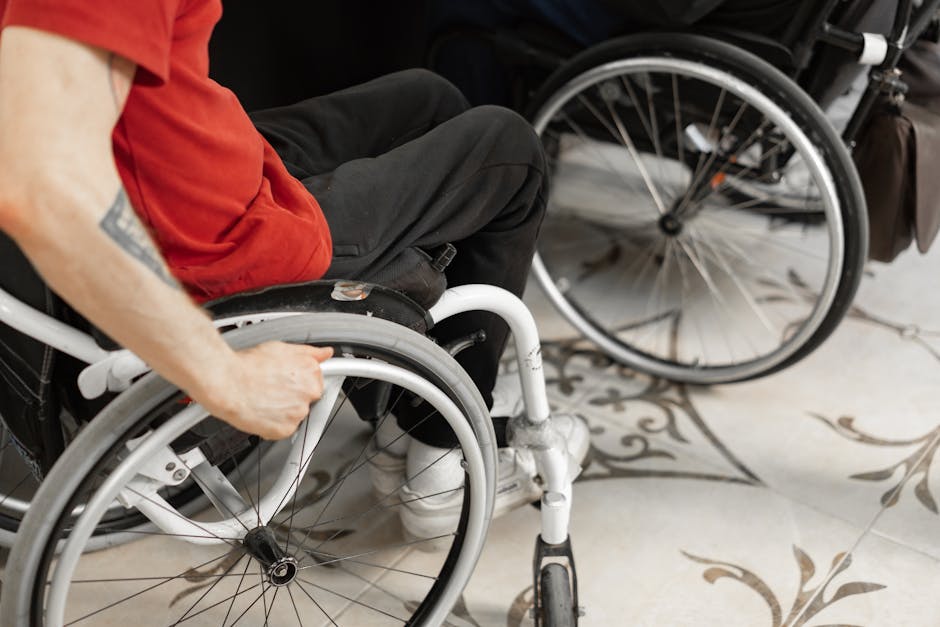
For individuals with paraplegia and lower cervical tetraplegia who can self-propel, the manual wheelchair is the cornerstone of daily mobility. The goal is an ultra-lightweight, custom-configured chair that maximizes propulsion efficiency and minimizes the risk of repetitive strain injuries to the shoulders and wrists.
Ultra-Lightweight Rigid Frame Chairs
Rigid-frame wheelchairs (non-folding) are the standard recommendation for active SCI users because:
- The rigid frame transfers propulsion energy more efficiently — less energy is lost to frame flex compared to folding chairs
- They are lighter overall, typically 15 to 25 lbs for the frame
- They are more durable and require less maintenance
- The rear axle position is fully adjustable, which is critical for optimizing push biomechanics
For a complete guide to manual wheelchair measurements and fit, see our manual wheelchair sizing guide.
Axle Position and Push Efficiency
The rear axle position relative to the user’s shoulder is one of the most important configuration settings on a manual wheelchair. Moving the axle forward (closer to the front of the chair) places the user’s shoulder directly over or slightly behind the axle, which creates a longer and more natural push stroke. This reduces the number of pushes needed to cover a distance, decreases peak forces on the shoulder joint, and lowers the long-term risk of rotator cuff injuries.
A seating specialist or physical therapist with SCI experience should set the axle position during the initial fitting. Getting this wrong leads to inefficient pushing, faster shoulder wear, and premature fatigue.
Push Rim Options
Standard chrome push rims are smooth and can be slippery, especially for users with limited hand grip (C6 and above). Alternatives include:
- Coated push rims with high-friction rubber or vinyl surfaces for users with weak grip
- Ergonomic push rims with an oval or contoured profile that increases hand contact area
- Projection push rims with knobs or pegs for users who push with the heel of the hand rather than gripping
The right push rim choice depends on the user’s hand function, grip strength, and pushing technique.
Power Wheelchairs for Spinal Cord Injury
Individuals with high cervical injuries (C1–C5) and some with C6 injuries use power wheelchairs as their primary mobility device. Choosing between a power and manual wheelchair is a significant decision — our guide comparing power wheelchairs vs. scooters explains the differences in capability and coverage.
Power Wheelchair Groups
Medicare classifies power wheelchairs into Groups 1 through 5 based on capability:
- Group 1–2: Basic and standard power chairs for flat indoor surfaces. Limited outdoor capability.
- Group 3: Mid-range chairs with powered seating functions (tilt, recline, elevating leg rests). Required for most SCI users because pressure relief seating is medically necessary.
- Group 4–5: Specialty chairs, including standing power wheelchairs and chairs with multiple powered seating functions. Common for high-level SCI.
Most individuals with cervical-level SCI need at minimum a Group 3 power wheelchair with tilt-in-space and recline functions for pressure management.
Alternative Drive Controls
When hand or arm function is insufficient for a standard joystick, alternative controls include:
- Mini joystick: Requires only finger movement. Suitable for C5–C6 injuries with limited hand function.
- Chin control: A joystick mounted on a swing-away arm positioned under the chin. Works for C3–C4 injuries.
- Sip-and-puff: The user sips or puffs air through a straw-like tube to control speed and direction. Used at C1–C3 levels.
- Head array: Pads positioned around the headrest detect head movements to steer. Works for C1–C4 injuries.
- Eye tracking and brain-computer interfaces: Emerging technologies for the highest injury levels. Still evolving but increasingly available.
A certified rehabilitation technology supplier (RTS) and the user’s physiatrist should collaborate on control system selection. For guidance on matching wheelchair type and configuration to specific injury levels, see our spinal cord injury wheelchair selection guide.
Standing Frames and Standing Wheelchairs
Standing is medically beneficial for individuals with spinal cord injuries, even when they cannot bear weight on their own. The health benefits of regular standing programs include:
- Bone density maintenance. Weight-bearing through the legs slows the bone mineral density loss that occurs after SCI, reducing fracture risk.
- Pressure redistribution. Standing shifts body weight off the sitting surfaces, providing complete pressure relief for the buttocks and sacrum.
- Improved circulation. Upright positioning promotes venous return and can reduce lower extremity swelling.
- Bowel and bladder function. Gravity-assisted positioning supports regularity and may improve bladder emptying.
- Psychological benefits. Eye-level interaction with others and the ability to reach elevated surfaces improve quality of life and social participation.
Static Standing Frames
A standing frame is a non-mobile device that supports the user in an upright position. The user transfers into the frame (or is lifted in), and straps secure the knees, hips, and trunk. Standing frames are used at home as part of a daily standing program, typically for 30 to 60 minutes per session.
Standing Power Wheelchairs
Standing power wheelchairs combine powered mobility with a seat that mechanically transitions from sitting to standing. The user can stand while remaining in their wheelchair, allowing them to stand during daily activities rather than dedicating separate time to a standing program. These chairs are significantly more expensive than standard power wheelchairs and typically require Group 4 or 5 classification for insurance coverage.
Seating and Pressure Management
Pressure injuries (also called pressure ulcers or decubitus ulcers) are one of the most serious secondary complications of spinal cord injury. Because SCI eliminates sensation below the injury level, the user cannot feel the warning signs of tissue breakdown. A comprehensive seating system is essential.
Cushion Selection
The wheelchair cushion must distribute pressure across the seating surface and accommodate the user’s pelvic shape. Common options:
- Air cushions provide excellent pressure distribution by allowing the user to float on interconnected air cells. They require regular inflation checks.
- Gel cushions conform to body contours and distribute pressure without the maintenance needs of air cushions.
- Foam cushions with mapped pressure zones offer a lower-maintenance option but may compress over time.
- Hybrid cushions combine foam, gel, and air elements for optimized pressure relief and stability.
Tilt and Recline Systems
Power wheelchairs with tilt-in-space and recline functions allow the user to shift weight off the sitting surfaces throughout the day. A tilt of 25 to 45 degrees effectively unloads the buttocks and sacrum. Recline opens the hip angle for additional redistribution. These features are considered medically necessary for most SCI power wheelchair users.
Regular wheelchair maintenance is especially important for SCI users whose cushions, seating systems, and power functions must remain in optimal condition to prevent skin breakdown.
Home Accessibility After Spinal Cord Injury
Returning home after an SCI typically requires significant modifications. The scope depends on the injury level, the home’s existing layout, and the user’s equipment.
Essential Modifications
- Entrance accessibility: At least one no-step entry with a ramp or ground-level approach. Doorways widened to 36 inches minimum.
- Bathroom: Roll-in shower with fold-down bench, handheld shower head, grab bars, and accessible sink. Toilet at wheelchair height with grab bars.
- Kitchen: Lowered countertops and cooktop, side-opening oven, pull-out shelving, lever-handle faucets, and accessible storage.
- Bedroom: Adequate turning space for the wheelchair, hospital bed or adjustable bed if needed, accessible closet.
- Flooring: Hard, smooth surfaces throughout. Carpet makes wheelchair propulsion significantly harder.
Our complete home accessibility checklist provides a room-by-room guide to planning modifications.
Funding Home Modifications
Home modifications can cost $5,000 to $50,000+ depending on scope. Funding options include VA Specially Adapted Housing grants for eligible veterans (see VA benefits for mobility equipment), state vocational rehabilitation programs, Medicaid waiver programs, and nonprofit organizations. Some modifications may be covered through Medicare if they are part of an approved DME setup.
Vehicle Modifications for Spinal Cord Injury
Driving after SCI is possible for many individuals with paraplegia and some with tetraplegia. The modifications needed depend on the injury level:
Paraplegia (T1 and Below)
Most individuals with paraplegia drive using hand controls (push-pull or twist-grip systems for gas and brake) and a steering knob. They transfer from their wheelchair into the vehicle seat and stow the wheelchair behind or beside them. Some use powered transfer seats or wheelchair loading systems.
Tetraplegia (C5 and Below with Some Hand Function)
Individuals with lower cervical injuries may drive from their wheelchair using a lowered-floor van with hand controls, reduced-effort steering, and adapted ignition and gear selection. A certified driver rehabilitation specialist evaluation is essential.
For a detailed overview of vehicle modification types, costs, and funding, see our guide on wheelchair accessible vehicles.
Building a Complete Equipment Plan
Spinal cord injury affects nearly every aspect of daily life, and no single piece of equipment addresses all needs. A comprehensive equipment plan developed with your rehabilitation team should include:
- Primary mobility device (manual wheelchair, power wheelchair, or both)
- Seating and positioning system (cushion, back support, head support if needed)
- Pressure management plan (weight shifts, tilt/recline schedule, cushion maintenance)
- Transfer equipment (transfer board, Hoyer lift, trapeze bar, or stand-pivot aids)
- Home modifications planned around your specific wheelchair dimensions and functional abilities
- Vehicle modifications if driving or riding in a vehicle while in the wheelchair
- Backup equipment including a backup cushion and a transport chair for medical appointments
Work closely with your physiatrist, occupational therapist, physical therapist, and assistive technology professional to develop this plan. Insurance pre-authorization and equipment ordering can take weeks to months, so start the process early during rehabilitation.
FAQ
What type of wheelchair is best for a new spinal cord injury?
The best wheelchair depends entirely on the injury level and completeness. For paraplegia (thoracic and lumbar injuries), an ultra-lightweight rigid-frame manual wheelchair custom-fitted by an assistive technology professional is the standard recommendation. For tetraplegia (cervical injuries at C5 and above), a power wheelchair with appropriate drive controls and powered seating functions is typically necessary. During initial rehabilitation, you will likely use a temporary or loaner chair while your custom chair is ordered. Work with your rehab team to get measured and evaluated for your long-term chair as early as possible, because custom orders can take 8 to 16 weeks.
How soon after a spinal cord injury should I get a custom wheelchair?
Custom wheelchair evaluation typically begins during inpatient rehabilitation, once your medical condition is stable and your functional level is reasonably established. This is usually 4 to 8 weeks post-injury for many individuals. However, your functional abilities may continue to improve for 12 to 18 months after injury, so your first custom chair should be configured to accommodate some change. A reassessment at 12 to 18 months and then every 3 to 5 years ensures your equipment continues to match your abilities.
Does insurance cover standing frames or standing wheelchairs for SCI?
Insurance coverage for standing equipment varies. Medicare may cover a standing frame as DME if the physician documents medical necessity (pressure injury prevention, bone density maintenance, spasticity management). Standing power wheelchairs (Group 4–5) require extensive documentation demonstrating that the standing function is medically necessary and that alternative interventions are insufficient. Many SCI centers have experience navigating this documentation process. Private insurance policies vary widely — check your specific plan’s DME benefits and prior authorization requirements.
Can someone with a complete spinal cord injury ever walk again with mobility equipment?
Some individuals with incomplete spinal cord injuries regain partial walking ability with the help of braces, crutches, walkers, or robotic exoskeleton devices. For complete injuries, powered exoskeletons can enable upright walking for exercise and limited community mobility, but they are not yet practical replacements for wheelchair use in daily life. Exoskeletons are slow, require upper body strength and balance support, and cannot navigate stairs or uneven terrain independently. They are best understood as therapeutic and exercise tools rather than primary mobility solutions. Research in this area is advancing rapidly, and future devices may offer greater functionality.
The MobilityLane Team
Written by a caregiver with 18+ years of experience supporting family members with chronic illness and mobility challenges, and medical training in mobility recovery. We research and write about mobility solutions to help people maintain independence and quality of life.
Learn more about us →Stay Independent, Stay Informed
Get our weekly guide to mobility solutions, funding tips, and home safety resources delivered to your inbox.
Thank you! Check your inbox to confirm your subscription.
Something went wrong. Please try again.
Join 1,000+ caregivers and families. Unsubscribe anytime.
Related Guides

Spinal Cord Injury and Wheelchair Selection: Matching Equipment to Injury Level
How spinal cord injury level affects wheelchair needs, from manual ultralight chairs for paraplegic users to power chair...
Manual Wheelchair Sizing Guide: How to Get the Right Fit
Learn how to measure for a manual wheelchair. Covers seat width, depth, height, footrest length, armrest height, and why...

Home Accessibility Checklist: Room-by-Room Safety Guide
A comprehensive room-by-room home accessibility checklist for seniors. Covers grab bars, ramps, lighting, bathroom safet...