
Table of Contents
Key Takeaways
- MS mobility needs fluctuate daily, so most people benefit from having more than one type of mobility aid available
- Ankle-foot orthoses (AFOs) and functional electrical stimulation (FES) devices are two distinct approaches to managing foot drop, each with specific advantages
- Fatigue is the most common MS symptom, making rollators with seats and lightweight wheelchairs essential tools for energy conservation
- Heat sensitivity affects roughly 60-80% of people with MS, so ventilated seating and cooling accessories should factor into every equipment decision
- National organizations like the NMSS and MSAA offer equipment assistance programs that can significantly reduce out-of-pocket costs
How Multiple Sclerosis Affects Mobility
Multiple sclerosis is a disease of unpredictability. Unlike many other progressive conditions such as ALS or muscular dystrophy, MS symptoms can shift from hour to hour, day to day, and season to season. Understanding the specific ways MS affects movement is the first step toward choosing the right equipment.
Fatigue is the single most common MS symptom, affecting roughly 80% of people with the condition. This is not ordinary tiredness. MS fatigue is a profound, whole-body exhaustion that can appear suddenly and without warning. Equipment that conserves energy (a rollator with a seat for rest breaks, a lightweight wheelchair for longer outings) is not a sign of giving up. It is a strategic tool for staying active.
Spasticity refers to muscle stiffness and involuntary spasms, particularly in the legs. It can make walking feel like pushing through resistance, throw off balance, and cause painful cramping. Spasticity often worsens with fatigue, heat, and stress.
Balance and coordination problems result from damage to the cerebellum and sensory pathways in the spinal cord. A person with MS may feel unsteady even when their legs are strong, because the brain is not receiving accurate information about foot placement and body position.
Foot drop occurs when weakness or nerve damage prevents the front of the foot from lifting properly during walking. The result is a dragging toe, a tendency to trip, and a compensatory high-stepping gait that burns extra energy. Foot drop is a primary target for both bracing and electrical stimulation devices.
Heat sensitivity (Uhthoff’s phenomenon) affects an estimated 60-80% of people with MS. Even a slight rise in core body temperature can temporarily amplify weakness, fatigue, spasticity, and vision problems. This has direct implications for equipment choices, from ventilated wheelchair cushions to cooling vests worn during activity.
Early-Stage MS: Maintaining Independence
In the early stages of MS, mobility challenges tend to be intermittent. A person may walk normally most of the time but notice foot drop when tired, stumble on uneven ground, or feel unsteady after physical exertion. The goal is targeted support that addresses specific problems without adding bulk or complexity.
Ankle-Foot Orthoses (AFOs) for Foot Drop
An AFO is a brace that wraps around the lower leg and foot to hold the ankle in a neutral position. For MS-related foot drop, it prevents the toe from dragging and provides a more natural gait pattern. Common types include posterior leaf spring AFOs (thin, flexible, fit inside a shoe), carbon fiber AFOs (lighter and more responsive, store energy for toe-off), and hinged AFOs (allow controlled ankle motion while preventing drop). A proper AFO requires a prescription and fitting by an orthotist. Insurance typically covers AFOs with a doctor’s prescription.
Forearm Crutches and Trekking Poles
Standard underarm crutches are rarely the best option for MS because they require significant upper body energy. Forearm crutches (also called Lofstrand crutches) are a better match. They provide stability while leaving hands partially free, and the forearm cuff keeps the crutch attached even if grip strength falters. For outdoor walking, adjustable trekking poles offer balance support without the medical appearance of crutches, and they distribute effort across four points of contact.
Walking Canes
A single-point cane can be helpful for mild balance issues. For MS specifically, consider an offset handle cane that positions weight directly over the shaft for better support, or a quad cane that provides a wider base of stability. For a detailed comparison of cane types, see our guide on the best walking canes for balance.
Moderate MS: Managing Fatigue and Variable Symptoms
As MS progresses or during periods of relapse, mobility challenges become more consistent. Fatigue may limit walking distance even on good days. Balance may require continuous support rather than occasional steadying. This is where rollators, cooling gear, and part-time wheelchair use become practical tools.
Rollators with Seats
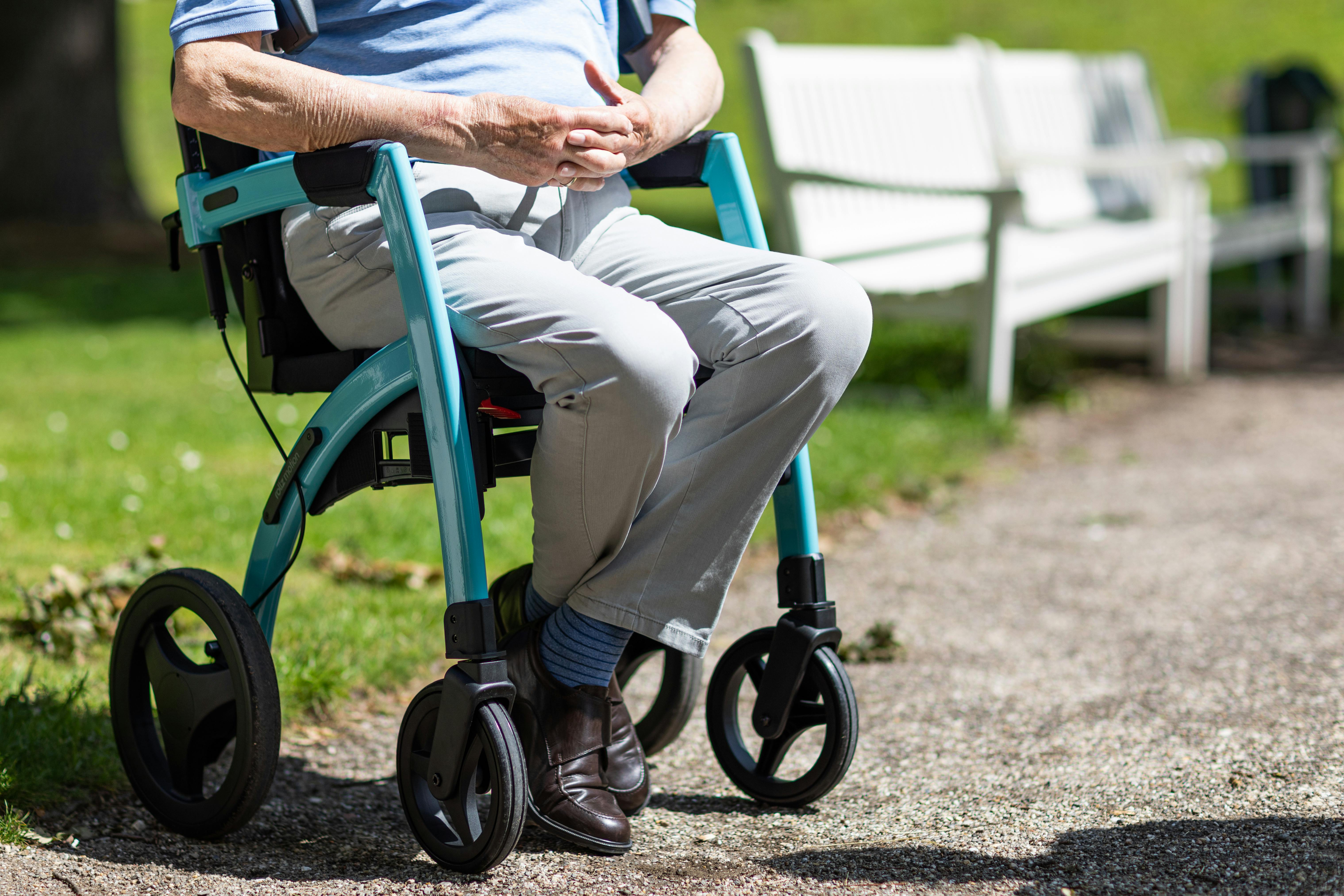
A rollator is often the single most impactful piece of equipment for someone with moderate MS. The built-in seat provides a place to rest when fatigue hits mid-walk, four-wheel stability means continuous balance support without lifting, and a storage basket means hands stay on the handles instead of carrying items.
When choosing a rollator for MS, prioritize lightweight construction (under 15 pounds if possible), comfortable hand brakes that do not require strong grip, and a padded seat wide enough for real rest. For a detailed comparison, see rollator vs. walker: which is right for you.
Cooling Vests and Accessories
Because heat sensitivity is so prevalent in MS, cooling equipment deserves a place alongside traditional mobility aids. The three main types are evaporative vests (soaked in water, best in dry climates), phase-change vests (gel packs that maintain about 59 degrees Fahrenheit for 2-4 hours, work in any climate), and active cooling vests (circulating cold water via a small pump, most effective but bulkiest). Cooling wraps for the neck and wrists are simpler alternatives. Some people find that wearing a cooling vest adds 30-60 minutes of comfortable walking time.
Part-Time Wheelchair Use
For some people with MS, a trained service or assistance dog provides functional help with retrieving items, opening doors, and bracing during balance loss.
Many people with MS resist the idea of a wheelchair because it feels like a concession. In reality, using a wheelchair strategically is one of the most effective ways to stay engaged in life. A lightweight manual wheelchair or transport chair for long outings conserves energy for the activities that matter. The key is to view the wheelchair as a tool, not a destination. MS mobility is variable, and your equipment should be variable too.
Advanced MS: Power Mobility and Standing Support
When walking becomes consistently difficult or unsafe, power mobility and standing equipment help maintain independence, social participation, and physical health.
Power Wheelchairs
For people with significant weakness in both legs or upper body involvement that makes pushing a manual chair difficult, a power wheelchair provides independent mobility without physical exertion. MS-specific considerations include joystick alternatives (head arrays, sip-and-puff controls) for hand tremor or weakness, tilt and recline functions for fatigue episodes, ventilated seat cushions for heat sensitivity, and simple programming to avoid overwhelming someone experiencing cognitive fatigue.
For a detailed comparison of power wheelchair types and mobility scooters, see our guide on power wheelchairs vs. scooters.
Mobility Scooters
Scooters work well for people whose primary limitation is walking endurance rather than trunk stability or upper body weakness. They require the ability to sit upright without support, operate a tiller with both hands, and transfer on and off independently.
Standing Frames
Prolonged sitting contributes to bone density loss, pressure injuries, and increased spasticity. Standing frames allow a person to spend time in a supported upright position, with benefits including improved bone density, reduced spasticity, and better bowel and bladder function. Powered standing wheelchairs combine mobility with the ability to rise to standing height, though they are significantly more expensive.
FES Devices for Foot Drop
Functional electrical stimulation (FES) is an alternative to traditional bracing for MS-related foot drop. A small device worn below the knee delivers mild electrical impulses to the peroneal nerve, causing the muscles that lift the foot to contract at the right moment during walking.
How FES Works
A sensor (usually in a heel switch or tilt sensor) detects when the foot leaves the ground. The device then stimulates the nerve, lifting the foot during the swing phase. When the foot contacts the ground again, stimulation stops. The result is a more natural gait pattern than most AFOs provide.
FES vs. AFO: Which Is Better for MS?
Both are valid options, and many neurologists recommend trying both. FES has the advantage of actively strengthening muscles over time, providing a more natural walking pattern, and not restricting ankle movement. AFOs have the advantage of working even when muscles do not respond to stimulation, requiring no batteries, costing less upfront, and performing consistently regardless of fatigue level.
Popular FES devices include the Bioness L300 Go and the WalkAide. Both require a prescription and professional fitting. Insurance coverage varies, so check with your provider before purchasing.
Home Modifications for MS
Adapting the home environment reduces fall risk and conserves energy for the activities that matter most. MS-specific modifications go beyond standard accessibility because they must account for fatigue, heat sensitivity, cognitive symptoms, and fluctuating ability levels.
Flooring
Remove all throw rugs and loose mats. Replace high-pile carpet with low-pile carpet or smooth flooring (hardwood, vinyl plank, or laminate). If carpet must stay, ensure edges are firmly tacked down. Transition strips between flooring types should be flush or ramped, never raised.
Doors and Hardware
Replace round doorknobs with lever handles, which require less grip strength and can be operated with an elbow or forearm. Widen doorways to at least 32 inches clear width for wheelchair access (36 inches is better). Pocket doors or barn-style sliding doors save the space and energy needed to swing a door open.
Smart Home Technology
Voice-controlled devices are particularly valuable for MS because they eliminate the physical effort of getting up to adjust thermostats, lights, locks, and appliances. A smart thermostat that maintains cool temperatures helps manage heat sensitivity. Smart lighting that responds to voice commands or motion sensors reduces the risk of walking through dark rooms.
Bathroom and Kitchen
The bathroom is the highest-risk room in any home. Key modifications include grab bars at the toilet and in the shower, a roll-in shower or tub transfer bench, a handheld shower head on an adjustable slide bar, non-slip flooring, and a raised toilet seat. In the kitchen, organize frequently used items between waist and shoulder height, install pull-out shelving in lower cabinets, and use a rolling cart to transport items. For detailed modification guidance, see our home accessibility checklist.
Insurance and MS-Specific Assistance Programs
Mobility equipment for MS can be expensive, but multiple funding sources exist.
Medicare and Private Insurance
Medicare Part B covers durable medical equipment (DME) that is medically necessary. This includes wheelchairs, rollators (with some limitations), AFOs, and certain FES devices. You will need a prescription from your doctor and, for power wheelchairs, a face-to-face evaluation and supporting documentation. Private insurance coverage varies by plan but generally follows similar requirements.
National MS Society (NMSS)
The NMSS offers financial assistance programs that can help with equipment costs. Their local chapters maintain lists of equipment loan programs, and their website has a comprehensive resource directory. Contact your local NMSS chapter directly for current program availability.
MS Association of America (MSAA)
The MSAA runs an equipment distribution program that provides wheelchairs, scooters, walkers, and other mobility aids to qualifying individuals. They also offer a cooling equipment distribution program specifically for people with heat-sensitive MS. Applications are processed based on financial need and medical documentation.
Other Resources
Every state has an Assistive Technology Act program that offers equipment loans, demonstrations, and sometimes financial assistance. Veterans with MS may qualify for mobility equipment through the VA healthcare system at no cost.
Building Your MS Mobility Toolkit
Rather than thinking of mobility aids as a progression from cane to wheelchair, think of them as a toolkit. You might use trekking poles for a morning walk, a rollator for grocery shopping, and a wheelchair for a day at the zoo. The right combination depends on your symptoms, your goals, and your daily energy budget.
Work with your neurologist and a physical therapist experienced with MS. Reassess every 6-12 months or after any significant relapse. For a detailed look at how to adjust your equipment plan as MS progresses through different stages, see our MS equipment progression guide. For guidance on how other neurological conditions affect equipment choices, see our guide on mobility equipment for Parkinson’s disease.
FAQ
What is the best mobility aid for someone newly diagnosed with MS?
There is no single best option because MS affects everyone differently. A good starting point is an AFO or FES device if foot drop is present, a cane for mild balance issues, or a rollator if fatigue limits walking distance. A physical therapist experienced with MS can assess your specific patterns and recommend the most appropriate equipment. Many people benefit from having two or three different aids for different situations.
Will using a wheelchair make my MS worse?
No. Using a wheelchair does not cause muscle atrophy or accelerate disease progression when used appropriately. Strategic wheelchair use conserves energy for exercise, therapy, and the activities you value most. The key is maintaining an active exercise program alongside mobility aid use.
Does insurance cover FES devices for MS foot drop?
Coverage varies by provider and plan. Medicare has covered certain FES devices under specific conditions. Many private insurers will cover FES with prior authorization, a prescription, and documentation that other interventions (like an AFO) were tried first. Contact your insurance provider before purchasing, and ask your neurologist’s office for help with prior authorization.
How do I manage mobility equipment in hot weather with MS heat sensitivity?
Start with a cooling vest (phase-change type works in any climate) worn under clothing during outdoor activity. Choose equipment with mesh or ventilated seating when possible. Plan outings during cooler parts of the day. Keep a cooling towel in your rollator basket or wheelchair bag. The MSAA cooling equipment distribution program provides free cooling vests to qualifying applicants.
When should someone with MS switch from a cane to a rollator?
Consider a rollator when fatigue regularly limits your walking distance, when you find yourself looking for places to sit during outings, when balance issues require more support than a cane provides on most days, or when you notice yourself avoiding activities because of concerns about endurance. The transition does not have to be all or nothing. Many people use a cane at home and a rollator for longer outings. If you are falling more than once a month, that is a strong signal to discuss equipment changes with your physical therapist.
Are standing frames worth the investment for MS?
For people who spend most of their day seated, standing frames offer measurable benefits including reduced spasticity, improved bone density, and better bowel and bladder function. Research supports standing programs of 30-60 minutes per day, several days per week. Manual standing frames typically cost $1,500-$4,000, but insurance may cover them with adequate medical documentation. Ask your physical therapist whether a standing program is appropriate before purchasing.
The MobilityLane Team
Written by a caregiver with 18+ years of experience supporting family members with chronic illness and mobility challenges, and medical training in mobility recovery. We research and write about mobility solutions to help people maintain independence and quality of life.
Learn more about us →Stay Independent, Stay Informed
Get our weekly guide to mobility solutions, funding tips, and home safety resources delivered to your inbox.
Thank you! Check your inbox to confirm your subscription.
Something went wrong. Please try again.
Join 1,000+ caregivers and families. Unsubscribe anytime.
Related Guides

Mobility Equipment for Parkinson's Disease: What Actually Helps
Expert guide to mobility equipment for Parkinson's disease. Covers U-Step walkers, laser cue devices, rollator tips, pow...
Rollator vs Walker: Which Mobility Aid Is Right for You?
Compare rollators and walkers side by side. Learn the key differences in wheels, brakes, seats, and stability to find th...

Power Wheelchair vs Mobility Scooter: Key Differences Explained
Compare power wheelchairs and mobility scooters side by side. Learn the differences in maneuverability, seating, Medicar...