
Table of Contents
Key Takeaways
- Parkinson’s disease creates unique mobility challenges — freezing of gait, festination, and postural instability — that require different equipment solutions than most other conditions
- Standard walkers and rollators can actually worsen mobility for some people with Parkinson’s, making specialized equipment evaluation essential
- Visual and auditory cueing strategies (laser lines, rhythmic sounds, and deliberate stepping patterns) are often more effective than traditional walking aids for managing freezing episodes
- Equipment needs change as Parkinson’s progresses, and what works in early stages may become problematic or insufficient in later stages
- A neurologist and physical therapist experienced with Parkinson’s should guide every equipment decision, as the wrong choice can increase fall risk
How Parkinson’s Disease Affects Movement Differently
Parkinson’s disease is a progressive neurological condition that affects the brain’s ability to produce dopamine, a neurotransmitter essential for smooth, coordinated movement. Unlike conditions that primarily affect strength (such as spinal cord injury) or range of motion (such as severe arthritis), Parkinson’s disrupts the motor planning and execution systems of the brain. This distinction is critical because it means equipment solutions designed for weakness or joint problems often do not work well — and can sometimes make things worse — for people with Parkinson’s.
For a comprehensive overview of mobility equipment options for Parkinson’s disease, our Parkinson’s mobility equipment guide covers the full range of devices. This article focuses specifically on how Parkinson’s-specific symptoms interact with equipment choices and the adaptive strategies that make the biggest practical difference.
The Core Movement Challenges
Bradykinesia is the hallmark of Parkinson’s — a slowness of movement that goes beyond simply being slow. Movements become smaller in amplitude (handwriting shrinks, steps become shorter, voice becomes quieter) and harder to initiate. Reaching for a grab bar or operating a walker brake requires more conscious effort and takes longer than it would for someone without Parkinson’s.
Rigidity refers to stiffness in the muscles that persists throughout the range of motion. Unlike the spasticity seen after stroke (which is velocity-dependent), Parkinson’s rigidity is constant. This affects the ability to shift weight smoothly, rotate the trunk during walking, and make the quick postural adjustments needed to maintain balance.
Tremor is the most visible symptom but usually the least disabling for mobility. Resting tremor (shaking that occurs when the hands are still) typically decreases during purposeful movement. However, tremor can make fine motor tasks like operating wheelchair joysticks or fastening equipment straps more difficult.
Postural instability develops as the disease progresses and is one of the leading causes of falls. The normal righting reflexes — the automatic reactions that keep you upright when you stumble or are pushed off-balance — become impaired. A small trip that a person without Parkinson’s would recover from easily can result in a fall.
Freezing of Gait
Freezing of gait (FOG) deserves special attention because it is one of the most disabling and least understood aspects of Parkinson’s. During a freezing episode, the person’s feet feel glued to the floor despite their intention to walk. Freezing is most commonly triggered by:
- Initiating walking from a standing position
- Turning, particularly 180-degree turns
- Approaching doorways or narrow spaces
- Navigating around obstacles
- Reaching a destination (terminal freezing)
- Stressful or time-pressured situations
Freezing is paradoxical in that it does not correspond to overall disease severity in a straightforward way. Some people with relatively mild Parkinson’s experience severe freezing, while others with advanced disease rarely freeze. Freezing episodes typically last seconds to minutes and can vary dramatically throughout the day depending on medication timing.
Festination
Festination is a pattern of walking in which the person takes increasingly rapid, short, shuffling steps while their center of gravity drifts forward. It looks as though they are chasing their own balance. Once festination begins, the person has difficulty stopping or slowing voluntarily, and falls — particularly forward falls — are common. Festination often occurs alongside freezing; the person may freeze, then break free into a festinating pattern.
Equipment That Works for Parkinson’s
Choosing mobility equipment for Parkinson’s requires understanding that the primary problem is not weakness or pain but disordered motor control. The best equipment provides external cues and structure that help the brain organize movement more effectively.
Cueing Devices
Visual, auditory, and tactile cueing is the most effective non-pharmacological intervention for freezing of gait. Cueing works by providing an external rhythm or target that bypasses the damaged basal ganglia circuits and engages alternative motor pathways.
Laser cane attachments. A small device that clips onto a cane or walker and projects a laser line on the floor in front of the person. The visual target gives the brain a specific place to step, which can break a freezing episode. Many people with Parkinson’s who freeze at doorways or when initiating walking find that a laser line allows them to step over it and resume walking.
Rhythmic auditory cueing. A metronome — either a standalone device, a smartphone app, or a feature built into some specialized walkers — provides a steady beat that the person matches their steps to. Walking to an external rhythm has been shown in research to increase step length, improve gait speed, and reduce freezing episodes. The optimal beat rate is typically set to match the person’s comfortable walking cadence or slightly faster.
Inverted cane technique. Some people with Parkinson’s find that stepping over an object breaks a freeze. An inverted cane (held upside down so the handle touches the floor ahead of the feet) provides an obstacle to step over, which paradoxically initiates walking when nothing else works. This is not a standard clinical recommendation but is a technique many individuals discover and find helpful.
Walkers and Rollators: Special Considerations
The relationship between Parkinson’s disease and walkers is more complicated than for most other conditions. Understanding the differences between walkers and rollators is important, but for Parkinson’s, the standard advice does not always apply.
Standard pickup walkers require the user to lift the walker, place it forward, then step into it. For someone with Parkinson’s, the stop-start nature of this movement pattern can trigger freezing. Each time the walker is placed down, the person must initiate a new walking sequence — and gait initiation is exactly where freezing occurs. Some people with Parkinson’s do well with standard walkers, but many find them worsening their mobility.
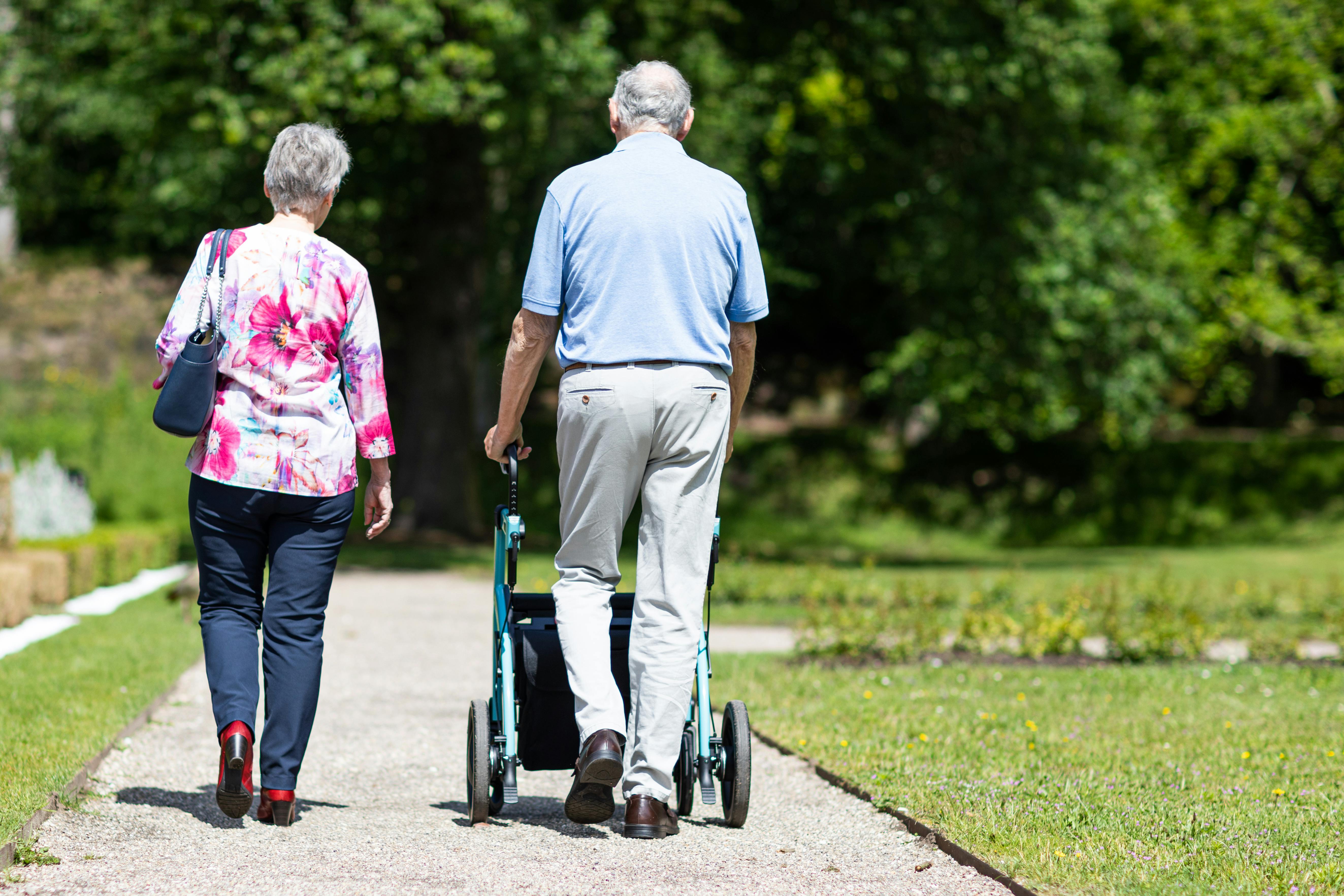
Standard rollators present a different risk. Because they roll freely, a rollator can run away from a person with Parkinson’s who is experiencing festination. As the person’s steps quicken and shorten, the rollator moves farther ahead, and the person leans forward trying to keep up, increasing the risk of a forward fall. The hand brakes on a standard rollator require grip strength and reaction speed that may be impaired.
U-Step walking stabilizer. This is a specialized walker designed specifically for neurological conditions including Parkinson’s. Its key features include a laser line that projects onto the floor for visual cueing, a reverse braking system (the walker brakes automatically unless the user squeezes the handles to release), and a weighted base that resists the tendency to run away from the user. The reverse braking mechanism is particularly important because it addresses the festination problem — if the person begins to festinate, the walker stops rather than accelerating ahead.
Weighted walkers. Adding weight to a standard walker or rollator (some models have compartments for this purpose) can provide resistance that helps control festination. The walker does not roll away as easily when it is heavier, though this comes at the cost of increased effort to move the walker forward during normal walking.
Canes
A well-chosen cane can be appropriate for people with mild to moderate Parkinson’s who have good hand function and primarily need balance support rather than cueing. However, canes have limitations for Parkinson’s:
- They do not address freezing of gait
- They provide minimal resistance against festination
- They require a level of coordination and reaction speed that diminishes as the disease progresses
- A cane in the wrong situation can become a tripping hazard during a freezing episode
Proper cane use technique is important for anyone using a cane, but people with Parkinson’s should receive specific training from a physical therapist familiar with the disease. The therapist can assess whether a cane genuinely improves safety or merely provides a false sense of security.
Wheelchairs
Wheelchairs enter the picture in later stages of Parkinson’s or during periods when medication is less effective (“off” periods). A wheelchair is appropriate when:
- Walking becomes unsafe despite optimal medication and walking aids
- Fatigue limits walking to very short distances
- The person needs to conserve energy for meaningful activities
- Cognitive changes make safe independent walking impossible
For some people, a wheelchair is used situationally (community outings, long distances, or during off periods) while walking aids remain appropriate for short household distances. This combination approach preserves walking ability for as long as possible while ensuring safety in demanding environments.
Home Environment Adaptations
The home environment plays a major role in managing Parkinson’s mobility challenges. A thorough home safety assessment should be conducted by an occupational therapist who understands Parkinson’s-specific risks.
Addressing Freezing Triggers in the Home
Doorways are among the most common freezing triggers. Strategies include:
- Placing colored tape on the floor at doorway thresholds to create a visual target to step over
- Widening doorways if possible, as narrow spaces worsen freezing
- Removing doors from interior doorways that are not needed for privacy
- Placing contrasting color strips on the floor to create visual stepping cues along hallways
Furniture placement should create clear, wide pathways. For people with Parkinson’s, obstacles in the walking path can trigger freezing or festination. Our home accessibility checklist provides a room-by-room framework.
Bathroom Safety
The bathroom presents concentrated risks for Parkinson’s — wet surfaces, confined spaces, and the need to turn in a small area. Caregiver fall prevention strategies are particularly important here. Install grab bars at the toilet, shower, and bathroom entrance, placing them to support turning (which is often harder than sitting or standing for Parkinson’s). Walk-in showers with zero-threshold entry are preferable since stepping over a tub edge requires the complex motor sequence Parkinson’s disrupts. Adding contrasting colors (dark toilet seat, colored grab bars) helps with reduced contrast sensitivity that is common in Parkinson’s.
Bedroom Considerations
Getting in and out of bed involves a sequence of movements that Parkinson’s disrupts: rolling, sitting up, scooting to the edge, standing. Satin sheets reduce friction for rolling, a bed rail provides a pull point for sitting up, and the bed height should allow feet flat on the floor when sitting at the edge. Nighttime mobility is especially risky because medications wear off during sleep. Motion-activated nightlights along the bedroom-to-bathroom path reduce disorientation and fall risk.
Medication Timing and Equipment Use
One of the most important but often overlooked aspects of Parkinson’s equipment management is the relationship between medication timing and functional ability. Most people with Parkinson’s experience “on” periods when medication is working well and movement is relatively fluid, and “off” periods when medication effects have worn off and symptoms return.
Equipment needs may genuinely differ between on and off periods. A person who walks safely with a cane during on periods may need a walker or wheelchair during off periods. Planning daily activities around medication timing — scheduling outings and physically demanding tasks during on periods — is a practical strategy that reduces equipment demands.
The physical therapist should evaluate the person during both on and off periods to provide appropriate equipment recommendations for each state. A single evaluation during an on period may result in equipment recommendations that are dangerously inadequate during off periods.
When to Reassess Equipment
Parkinson’s is progressive, and equipment that is appropriate today may become inadequate as the disease advances. Reassess when falls or near-falls increase, freezing episodes are no longer managed by current equipment, festination occurs despite current aids, the person avoids activities because equipment does not feel safe, or medication changes significantly alter mobility. A physical therapist specializing in neurological conditions should reevaluate equipment at least annually. Visit our walking aids page and wheelchairs page for comprehensive information on equipment types that may become relevant as needs evolve.
Insurance Coverage for Parkinson’s Equipment
Standard mobility equipment (walkers, rollators, canes, wheelchairs) is covered by Medicare and most insurance plans when prescribed as medically necessary. Specialized Parkinson’s equipment such as the U-Step walker may require additional documentation justifying why standard equipment is not appropriate.
Cueing devices (laser cane attachments, metronomes) are generally not covered by insurance as they are classified as accessories or personal devices rather than durable medical equipment. These items are typically purchased out of pocket, with costs ranging from $15 for a metronome app to $50-100 for a laser cane attachment.
Visit our funding and insurance hub for comprehensive coverage information, and use our Medicare coverage checker to get a quick estimate for specific equipment types.
Frequently Asked Questions
Are rollators safe for people with Parkinson’s disease?
Standard rollators can be problematic for people with Parkinson’s who experience festination because the rollator can roll away faster than the person can control it. However, some people with Parkinson’s do well with rollators, particularly in early-to-moderate stages when festination is not a significant issue. A rollator with a built-in seat provides a rest option, which is valuable for managing fatigue. The key is a thorough evaluation by a physical therapist who understands Parkinson’s-specific gait patterns. Specialized walkers with reverse braking systems are a safer alternative for those with festination.
What is the best walking aid for someone who freezes when walking?
There is no single best walking aid for freezing of gait because different strategies work for different people. Visual cueing devices (laser lines projected on the floor) are the most consistently effective intervention. A metronome or rhythmic music can help maintain gait initiation and prevent freezing. The U-Step walking stabilizer combines visual cueing with a reverse braking system. Your physical therapist can trial different options to determine which cueing method is most effective for your specific freezing pattern.
How do I know when it is time to start using a wheelchair with Parkinson’s?
The transition to a wheelchair is appropriate when walking becomes unsafe despite optimal medication management and appropriate walking aids. Specific indicators include frequent falls (more than one per month), inability to walk household distances without extreme fatigue, freezing episodes that consistently lead to falls, and cognitive changes that impair judgment about safe mobility. Many people benefit from a combined approach — using walking aids for short distances and familiar environments while using a wheelchair for community outings and longer distances.
Can exercise reduce the need for mobility equipment in Parkinson’s?
Exercise is one of the most powerful interventions for Parkinson’s disease and has been shown to slow disease progression, improve balance, increase walking speed, and reduce fall risk. Activities with strong evidence include boxing training, tango dancing, Nordic walking, tai chi, and intensive treadmill training. Regular exercise may delay the need for mobility equipment or allow the person to use less supportive equipment than they would otherwise need. However, exercise does not eliminate the need for appropriate safety equipment, and both should be pursued simultaneously.
Should I buy Parkinson’s-specific equipment or will standard equipment work?
It depends on your symptoms. In early Parkinson’s, when symptoms are mild and well-controlled by medication, standard equipment often works well. A regular cane or rollator may provide the balance support you need. As the disease progresses and symptoms like freezing, festination, and postural instability become more prominent, Parkinson’s-specific equipment (cueing devices, reverse-braking walkers) may become necessary. The cost of specialized equipment is higher, so it makes sense to start with standard equipment and transition to specialized devices when standard options no longer manage your symptoms safely.
The MobilityLane Team
Written by a caregiver with 18+ years of experience supporting family members with chronic illness and mobility challenges, and medical training in mobility recovery. We research and write about mobility solutions to help people maintain independence and quality of life.
Learn more about us →Stay Independent, Stay Informed
Get our weekly guide to mobility solutions, funding tips, and home safety resources delivered to your inbox.
Thank you! Check your inbox to confirm your subscription.
Something went wrong. Please try again.
Join 1,000+ caregivers and families. Unsubscribe anytime.
Related Guides
Mobility Equipment for Parkinson's Disease: What Actually Helps
Expert guide to mobility equipment for Parkinson's disease. Covers U-Step walkers, laser cue devices, rollator tips, pow...

Caregiver's Guide to Preventing Falls at Home
Evidence-based fall prevention strategies for caregivers. Covers risk factors, room-by-room hazard checks, exercises, me...

Best Walking Canes for Balance Problems: Expert Picks
We reviewed the 7 best walking canes for balance problems. Compare single-point, offset, quad, folding, and seat canes w...